
5.3.5 Moose / Jëjik
Given that moose have always been there for us and have been a long-standing source of our survival, we agree to treat them with the utmost respect and not to take their lives for granted. Every year, we see people from down south come up and take moose from our family hunting spots, their bodies and racks hung in the back of trucks heading out of town. It is our responsibility to care for our moose. We can’t leave them to fend for themselves with all these hunting pressures and lack of regard for their natural habitat.
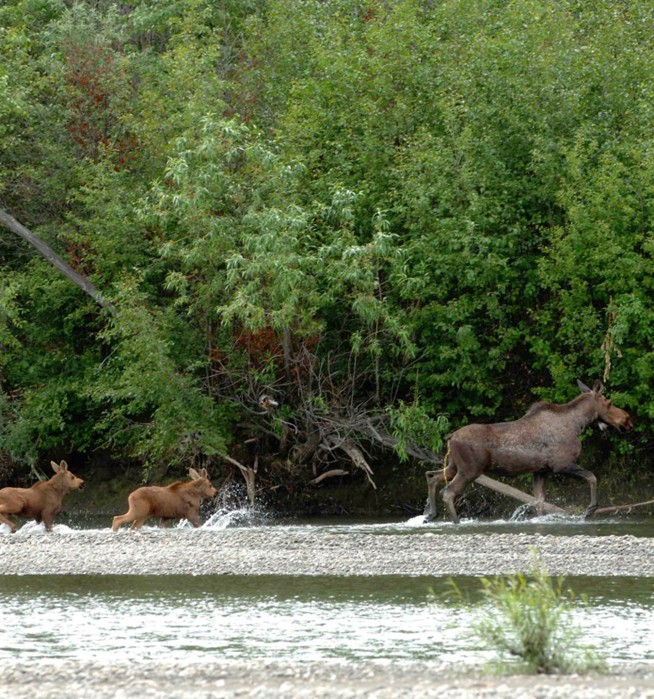
Photo: Government of Yukon
Moose are a species of cultural significance to the Tr’ondëk Hwëch’in. They provide a major component of a traditional diet as well as hides and other materials that are used in crafts, clothing, and artwork. Moose hunting is an important seasonal activity for many people of all backgrounds in the Region, helping them connect to the land and access country foods. People also come from elsewhere in the territory to hunt moose.
Moose use different habitats depending on the season, their sex, and stage of life. Throughout the year, moose balance finding good quality food (including willows, aspen, and birch shrubs), avoiding predation, and limiting their energy use. In spring and summer, moose can be found in riparian areas, wetlands, and mineral licks.
In the fall, during rut, moose travel widely. Winter movements depend largely on snowfall. Late winter can be the hardest time of year for moose. Snow makes it difficult to travel, reach food, and escape predators, especially during years of high snowfall. Certain areas used in late winter are defined by the Government of Yukon as Wildlife Key Areas (WKAs) for moose because they are critical for survival. Calving sites are also important to protect, and local knowledge is required to inform where these are.
Predicting how moose will respond to impacts from climate change is difficult. It is important to monitor these responses as conditions change. Projected increases in snowfall could make late-winter key habitats even more important. Higher temperatures could lead to increases in food availability, but also increase pests, parasites, and diseases, such as mosquitoes and ticks.
The Government of Yukon manages activities that affect moose, such as land use and harvest, at the scale of Moose Management Units (MMUs). It supports a management approach that maintains and restores intact ecosystems. The Government of Yukon carries out periodic population surveys by MMU. It selects MMUs for surveys based on factors including length of time since the last survey and past, current, and anticipated harvest levels and land-use activities.
While management and monitoring often focus on areas with high harvest, it is also important to protect areas with less harvest and development pressure. Animals can move from these areas to support harvest in easier-access areas.
… they use just about everything, then they teach the young people about it … like even the hooves like, a hoof of the moose or caribou. What they do there they save the hoof like the caribou leg or hoof or whatever moose on their trail as they go along they hang it up, all the way down the trail in case somebody’s hungry. They boil it and then they eat that …
Key Planning Issues
- Moose are a culturally significant species for Tr’ondëk Hwëch’in.
- Moose are important for subsistence and licensed harvest.
- Human land use can affect important moose habitat, including Wildlife Key Areas and calving areas.
- Moose, predators, and hunters all use linear features (for example, roads and trails); increased use and development of linear features can increase harvest and predation pressure.
- New roads and trails contribute to habitat fragmentation.
- Disturbance during calving, or in calving areas, poses a risk to the moose population.
- The projected increase in snowfall due to climate change increases the importance of already critical late-winter habitat.
- The response of moose to combined climate change impacts is hard to predict.
- Hunting can conflict with other land uses.
Goals
- The Region maintains a resilient, healthy, and sustainable moose population.
- The Region’s residents can sustainably harvest moose into the future, at levels that meet their needs.
Stewardship Directions
- Avoid or minimize development within movement corridors and areas of high or seasonal use. Specifically, avoid development in calving areas, areas of post-rut aggregation, and late-winter habitat (WKAs).
- Avoid or minimize new access where access is currently limited or where access will result in “loop roads” connections.
- During years of high snowfall, avoid activities that could disturb moose WKAs in late winter (February 15 to March 31).
- In spring and summer, be alert for the presence of cow and calf moose in riparian areas and avoid disturbing them.
- When undertaking development or activities in riparian areas, consider calving areas identified by local knowledge-holders.
Implementation Actions
- Continue to monitor moose population density, abundance, and composition, especially in areas that experience significant access, development and hunting pressure.
- Limit habitat fragmentation by decommissioning roads that are no longer in use, and prioritize using existing access over creating new access.
- Prioritize analysis and publication of data from moose surveys so that data are still relevant when shared.
- Increase frequency of moose surveys, responding to local and Traditional Knowledge when selecting MMUs.
- Collect data on licensed hunter residency (for example, to track where hunters are harvesting in relation to where they live) to inform future educational campaigns.
- Support DDRRC recommendations on moose management, if required.
- Revise moose WKAs based on incorporation of Traditional Knowledge and local ecological knowledge.
- Review the MMUs to assess whether the current boundaries are meeting the needs of managers, hunters, the landscape, and moose.
Per Implementation Action 1, start work on cumulative effects indicators and related elements for this value by the end of year four.
Knowledge Gaps
- Improve mapping of important riparian habitat used for calving, and describe how land use activities affect these areas.
- Implement targeted monitoring of snowfall in key late-winter habitats.
- Research cumulative effects indicators and thresholds based on moose habitat.
- Continued work to identify key mineral licks and find ways to protect them from disturbance.
- Conduct a long-term study that uses moose and socio-cultural indicators in reclaimed placer areas where moose is a priority value. Use the results to further define “successful” reclamation and its effects on the community.