
3.0 Cumulative Effects Management
3.1 Introduction
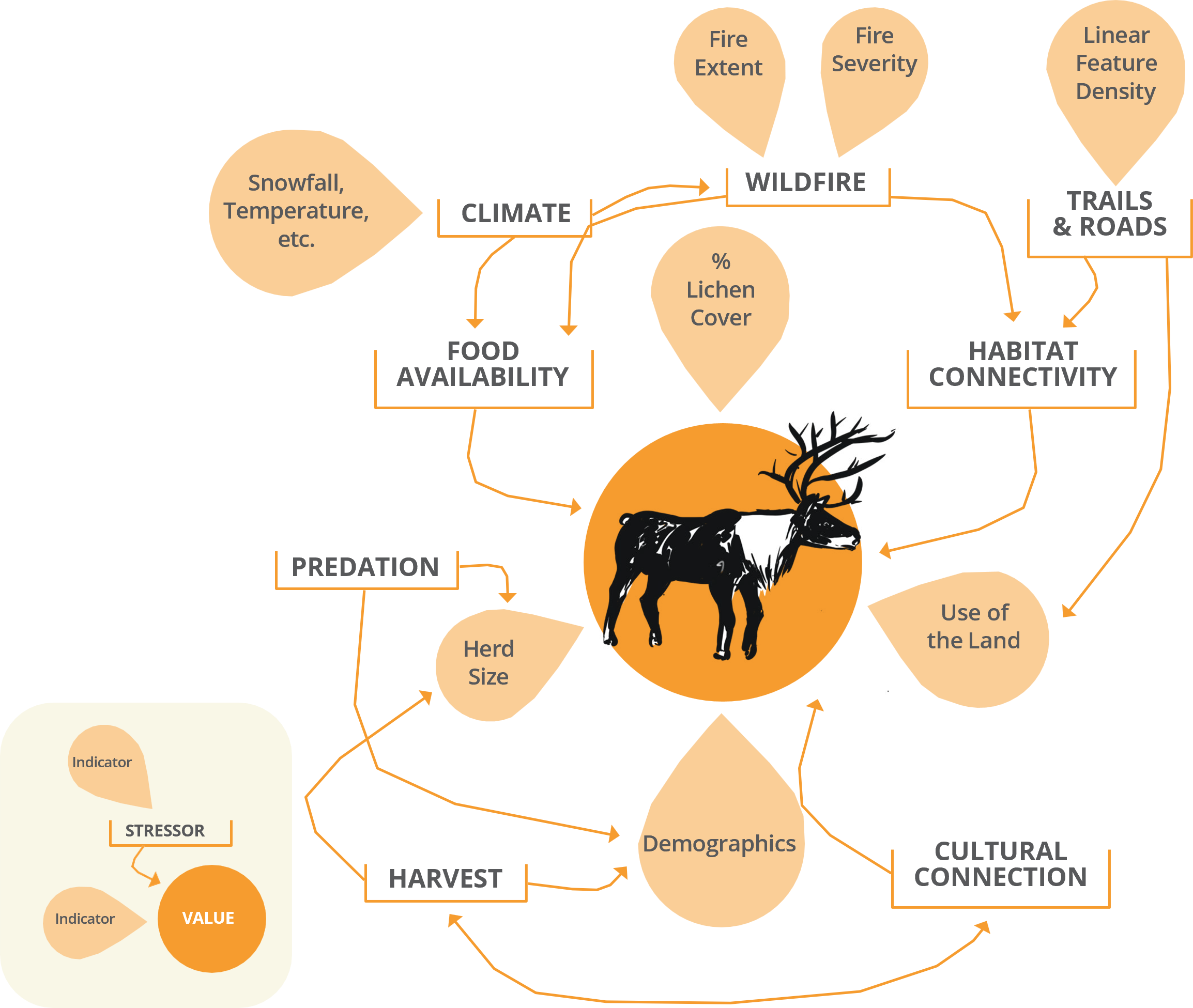
Cumulative effects are the combined changes to values in the environment and/or society that result from past, present, and future human activities and natural processes (for example, Figure 4). Plan values are what matter to people who live in and have a relationship with the Region (Section 2.3.1). When values become unhealthy, people, the land, and the relationships between people and the land suffer. For Tr’ondëk Hwëch’in, these relationships are a recognized human right.
The Plan requires cumulative effects management to make sure the impacts from different activities and events don’t add up and cause harm. This is a way of protecting values well into the future. It does this by centring land-related decisions on values. The cumulative effects framework defines the components and processes involved in cumulative effects management. Some parts are ready to use right away, and others will need considerable work. As the Parties apply and improve cumulative effects management, they will protect an increasing number of the Region’s values for current and future generations. The Plan envisions the Region’s residents having access to up-to-date information on value health and on what actions governments and partners are taking to protect them.
Why do we need cumulative effects management?
All values are part of interconnected systems that can be affected by human activities and gradual (for example, slow climate shifts) and sudden (wildfire or flooding) environmental change (“stressors”). In the Region, human activities currently go through assessment project-by-project and are managed on an industry-specific basis (for example, each placer mine goes through its own impact assessment, and placer mines are managed under separate regulations from timber harvest, tourism, or quartz mines). Managing responses to environmental change happens separately from managing human activities.
Cumulative effects management involves using a holistic approach that considers a wide variety of stressors to monitor, assess, and respond to changes in value health. It focuses on values instead of individual projects, industries, or environmental factors, so that impacts from different stressors can be considered together. The Plan’s scope and scale make it an appropriate place to address cumulative effects.
Figure 4: Cumulative effects are all the effects that affect a value (stressors). This example shows some of the stressors that affect Caribou (the value). It also shows examples of indicators that we can measure to track value health, either by measuring the value itself (e.g., caribou herd size) or the stressors (e.g., snowfall). It is impossible to show, measure, or manage all of the things that affect caribou; cumulative effects management uses indicators that give a good picture of how the value is doing and always remains focused on the value.
In addition, YESAA requires assessors to consider the “significance of cumulative effects” (s. 42.1.d) when evaluating a project. This is difficult because the nature of cumulative effects means that the knowledge required to assess them is beyond the scope of any individual project. Implementing the Plan’s cumulative effects tools will directly support YESAB in carrying out its mandate.
Why do we need a cumulative effects framework?
Cumulative effects management requires coordination among governments, agencies, industry, and other stakeholders because multiple bodies are responsible for regulating and responding to stressors and for monitoring the health of values. The Plan’s cumulative effects framework is a relational structure of the elements involved in cumulative effects management. It provides a common understanding of components and processes to guide this coordination, including direction on how to improve these over time.
As of March 2026, the Government of Yukon is developing a territory-wide Ecological Cumulative Effects Framework. When this, or other broad-scale cumulative effects guidance, is complete, the Parties should consider how best to integrate it with the Plan’s framework. Such guidance should only supersede that in the Plan if it provides greater protection to Plan values.
The Plan is not a complete guide to cumulative effects management. Rather, it provides multiple tools for managing cumulative effects in the Region. These tools are intended to be used and improved simultaneously, so that the number of values protected and the effectiveness of that protection increase over time. To avoid unnecessary complexity, tools may be retired as new and better ones are developed.
The tools are as follows:
- Cumulative effects framework to guide development of value-based indicators and related components and processes (Section 3.2 – 3.10).
- Reclamation framework to guide values-based reclamation (Section 3.11).
- Management directions framed around values (Section 5).
- Goals for each value that provide benchmarks against which value health can be measured to direct appropriate action (Section 5).
- Two broad indicators of human development footprint with tiered thresholds that trigger management responses to protect values, applied at the scale of Landscape Management Units (LMU) (Section 6).
- Priority values for each LMU (Section 6).
- Suites of management directions applied through overlays to serve values whose needs aren’t met by LMU boundaries – for example, Section 5.3.4.
This section first describes the framework, then provides details on each element of cumulative effects management and defines how elements may be added, revised, or removed. It then describes the use of cumulative effects in overlays and the reclamation framework.
Implementation Actions, Governance Recommendations, and Knowledge Gaps relevant to the currently available management tools are included throughout Sections 3.3 to 3.8. Implementation Actions regarding the development of framework processes and components are found in Sections 3.2 and 3.9. No specific Stewardship Directions are found in this section. While cumulative effects management is largely the responsibility of decision-makers and managers, the effects on the ground are necessarily made up of individual actions. Following the Stewardship Directions throughout the Plan is a way everyone can help to minimize negative and maximize positive cumulative effects to the Region’s values.
See Appendices 1 and 5 for selected resources for learning more about cumulative effects and their management, including indicator selection.