
3.2 Cumulative Effects Framework
The Plan envisions future cumulative effects management in the Region where:
- Plan values have indicators with thresholds.
- Indicator monitoring feeds into publicly accessible value health assessments.
- Cumulative effects assessments are integrated into project-level assessments and long-term, broad-scale planning.
- Decision-makers respond quickly and appropriately to protect value health.
For this to happen, the Parties will need to co-develop many components and processes. The following section presents a framework that defines these elements and how they relate. It also explains how they should be developed, and what is available in the meantime. The Parties are responsible for “filling in” this framework over time. They must make decisions using the best available information while they are doing so.
Defining Terms
Cumulative effects management uses specific terms that need to be understood in the context of a value. A stressor for one value might be a value in its own right, or an indicator for another value. For example, wildfire extent is a stressor on caribou habitat and could also be an indicator of climate change.
Cumulative Effects: The combined changes to values in the environment and/or society that result from past, present, and future human activities and natural processes.
Cumulative Effects Management: Monitoring, assessing, and responding to changes in value health, using a holistic approach that considers a wide variety of stressors.
Cumulative Effects Framework: A relational structure of the elements involved in cumulative effects management.
Value: An element of, or relationship or system dependent on, the land, that is important to people in the Region. It often supports the integrity and well-being of communities, the environment, and/or economies.
Stressor: An environmental or societal factor that affects a value, positively or negatively.
Indicator: A measurable factor (qualitative or quantitative) that is related to a value and used to track value health.
Threshold: The level at which an indicator triggers a change in management responses. It can refer to a type of threshold (for example, cautionary or critical) or to a specific number (for example, the critical threshold for surface disturbance for LMU 18 is 4%). In this Plan, “threshold” means a management threshold. It can be based on, but is distinct from, a system threshold (for example, the level of disturbance at which caribou avoid an area).
Monitoring: Knowledge gathering related to indicators that helps inform assessment.
Assessment: The process of reviewing available knowledge on value health in relation to value goals. This often includes comparing indicator data to thresholds and using the results to guide responses. Conformity determinations are a form of assessment.
Response: Actions that limit, stop or reverse negative effects on a value, and/or increase positive effects.
Component and Process Summaries
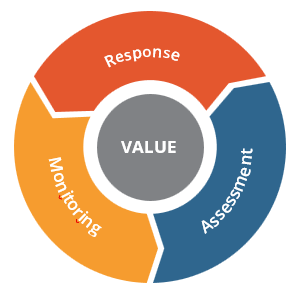
The following summaries describe how each component (Figure 5) and process (Figure 6) fits into the Plan’s framework. Each summary describes how the element links to others, what it does when the framework is fully realized, what is needed to get there, and what initial tools are in place at the outset of Plan implementation. These summaries appear at the beginning of each element subsection as an aid to the reader.
Figure 5: How cumulative effects components are related. An indicator is always related to at least one value. A threshold is established for a given indicator. The value remains central to all decisions.

Figure 6: How cumulative effects processes are related. Indicator monitoring feeds into cumulative effects assessments that look at value health and compare it to thresholds and goals. The results of assessments dictate responses aimed to maintain or restore value health. Monitoring continues to assess whether the responses are effective, and the cycle repeats. The value remains central to all decisions.
Indicator thresholds are indicator levels that communicate target, cautionary, and critical health ranges for the related value. Crossing a threshold triggers management actions to slow, stop, or reverse a negative trend in value health. The Parties will establish thresholds for each value-based indicator they develop. In the meantime, each LMU has thresholds for two development footprint indicators to guide decisions.
Indicator monitoring shows value health and alerts decision-makers when health is approaching a threshold. Once the Parties identify indicators and set thresholds for Plan values, they will need to set up monitoring programs or integrate existing ones. The data they (and Plan Partners) collect on indicators will inform assessments of value health. It will also trigger management responses. In the meantime, the Parties will monitor the development footprint indicators. Additionally, decision-makers will rely on ongoing monitoring related to values, especially priority values in each LMU. The Plan’s values provide a scaffold to bring together monitoring from different sources. This helps decision-makers make the best decisions, even in the absence of formal cumulative effects components.
Assessment reviews available knowledge on value health and compares this to value goals. It often uses indicators and thresholds and leads to conclusions that direct appropriate responses. Knowledge comes in many forms, often from monitoring. Assessment considers past health, anticipated health, and trends. Cumulative effects assessment will inform the Commission’s conformity determinations. The Parties will need to work with YESAB and those involved in other processes to integrate cumulative effects assessment on an ongoing basis. They must do this as more framework components become available. In the meantime, decision-makers will use the best available information on value health in the context of value goals. They will also use development footprint indicator levels relative to LMU thresholds to inform conformity determinations specifically, and project assessment more broadly.
Responses are all the actions that decision-makers take to maintain, encourage, or restore value health, as defined by value goals. The Plan provides broad guidance on appropriate responses to value health ranges (target, cautionary, critical). Once the Parties identify indicators and set thresholds for Plan values, they will need to identify more specific responses that apply when indicator levels reach each threshold. In the meantime, the Plan provides objectives for management actions based on development footprint indicator levels, and recommends specific responses. The Parties will begin expanding consideration of cumulative effects in ongoing management and decision-making, including giving weight to cumulative effects assessments completed at the project level.
Implementation Actions
- Develop cumulative effects indicators and related elements for Plan values according to the following timeline and directions. Work on multiple values in parallel and incorporate elements into cumulative effects management as they become available (all components for a value do not need to be complete before they are used). The Parties will make all decisions on adding components to the framework as equal decision-makers. This is an expression of co-management (see Section 3.9 for further details on adding, revising, and removing components).For each value:
- Conduct a comprehensive value review that brings together multiple ways of knowing about the value (current health, trends, known responses to disturbance and mitigation, existing monitoring, and data availability, and so on).
- Select one or more indicators for the value using models that include the value’s relationships with other values and stressors – for example, causal models as described in the Marine Plan Partnership, conceptual models used by the BC Environmental Assessment Office, and influence diagrams as used in Metlakatla Cumulative Effects Management.
- Trial each indicator over an agreed-upon period. Then, assess each one to ensure it is relevant, sensitive, practical, and accurate.
- Establish tiered thresholds using the best available knowledge. Critical thresholds should be below the point beyond which recovery is unlikely without human intervention. Cautionary and advisory thresholds should provide enough room for proactive actions to prevent reaching critical thresholds.
- Clarify specific roles and responsibilities for monitoring.
- Identify management actions to take at each threshold, along with responsibilities, following the guidance above.
Start work on Land–People Relationship, Water, Salmon, Caribou, and Wetlands by the end of year two, and Community Resilience, Moose, and Sustainable Local Economy by the end of year four. This timeline considers value health, threats, knowledge gaps, and “nested” values, where protecting one is likely to protect others. Community Culture, Tr’ondëk Hwëch’in Culture, Heritage, and Hän Language, Plant and Animal Relations, and Landscapes are not prioritized for completion in the first four years. However, this does not mean they are less important than the prioritized values.
- Incorporate disturbance from fire (including quantifying burn severity and post-fire ecosystem recovery) and permafrost thaw into cumulative effects management.
- Report annually on the progress of cumulative effects framework elements (see guidance in Appendix 5).
- Report annually on value health, including health range (once indicators and thresholds are established), health status relative to value goal(s), and/or inadequacies in data.
Governance Recommendations
- Consider and complement the Plan’s cumulative effects framework when developing the territory-wide Ecological Cumulative Effects Framework (Government of Yukon).
- Once the Government of Yukon’s territory-wide Ecological Cumulative Effects Framework is complete, the Parties will review the Plan’s cumulative effects framework and revise it if necessary to maintain the highest standard of value protection.
Knowledge Gaps
- Relationships between initial values identified for cumulative effects development and potential indicators are not well characterized. Research is needed to inform the selection of indicators, setting of thresholds, and appropriate responses, and to prioritize research based on the value timeline in Implementation Action 1.
- There are many ways to incorporate projected climate change impacts on values and land use patterns, including disturbances from wildfire and permafrost thaw, into cumulative effects management. Research these options to identify the most promising and achievable approaches.
- There is a limited understanding of the responses of Plan values (especially Caribou, Moose, Salmon, Wetlands, Tr’ondëk Hwëch’in Culture, Heritage, and Language and Land–People Relationship) to human-caused and natural disturbance (independently and in combination). Research these responses to inform adaptation of development footprint indicators, selection of appropriate responses, and development of new indicators.
Select a component to learn more about it.