
3.5 Thresholds
Indicator thresholds are indicator levels that communicate target, cautionary, and critical health ranges for the related value. Crossing a threshold triggers management actions to slow, stop, or reverse a negative trend in value health. The Parties will establish thresholds for each value-based indicator they develop. In the meantime, each LMU has thresholds for two development footprint indicators to guide decisions.
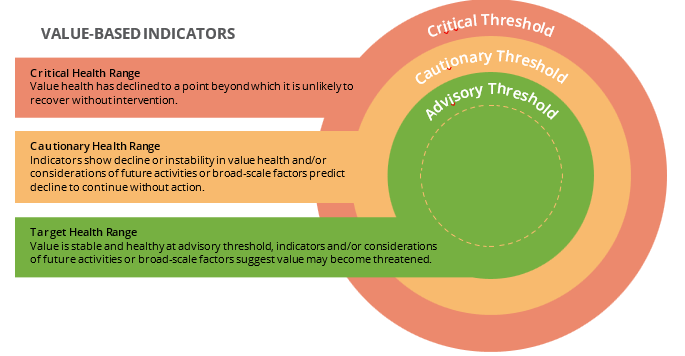
The cumulative effects framework uses tiered thresholds to provide clear direction for recommendation bodies and decision-makers. These thresholds aim to maintain value health (Figure 7). The cautionary and critical thresholds mark boundaries between value health ranges (target, cautionary, and critical) that require different suites of responses (Section 3.8). The Plan also includes an “advisory” threshold within the target health range to support proactive management. The Plan’s management directions aim to maintain value health within the target range.
It is important to identify critical thresholds, the points beyond which urgent intervention is required. However, focusing only on critical thresholds can lead to reactive responses that may be too late to protect value health, and these responses are often more costly than preventative measures.
The Plan’s tiered threshold structure encourages proactive management by prompting early action if value health begins to decline. It also lays the groundwork for swift and efficient responses if value health approaches the critical threshold. Value health will change over time in response to changes in the environment, as well as human activities. Stewardship actions like reclamation and habitat enhancement can increase value health. Over time, they can bring it below thresholds that require restrictions on activities or development, subject to future development of reclamation guidance (Section 3.11).
Figure 7: Tiered threshold structure for value-based indicators, showing value health ranges bounded by the thresholds. Cumulative effects management aims to keep value health within the target range.
Thresholds should be based in Indigenous and/or Western science. They should follow the precautionary principle and express humility about the complexity of natural systems. Thresholds may be established at the LMU-scale, or through an overlay.
Note that unless otherwise specified, “threshold” means a management threshold – a threshold established for the purposes of decision-making – not a natural threshold present in a system – for example, a tipping point for herd health in caribou, or a level of income required for a basic standard of living.
Management thresholds are often based on natural thresholds but consider other factors as well.
The following are some of the factors the Parties should consider when setting thresholds, using caribou as an example.
- Jurisdiction: Herds migrate across human-created boundaries – for example, Yukon–Alaska.
- Time between action and reaction: By the time tipping points in herd health are observed, it can be too late for effective responses or, ecosystems may take decades or centuries to recover from disturbance.
- Social factors: Actions taken to protect a herd may result in pushback if the public is not kept informed over time about herd health and reasons for action.
- Connections between values: Higher linear feature density leads to avoidance by Caribou, but increased access for harvest or recreation, which support other Plan values such as Land–People Relationship. Thresholds should be set independently for each indicator, but indicators for multiple values should be considered together in the context of the vision for each LMU.
Development Footprint Thresholds
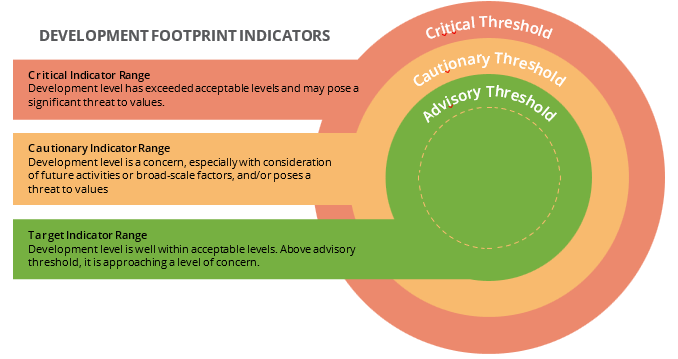
The development footprint threshold structure mirrors that for value-based indicators. Cautionary, and critical thresholds define target, cautionary, and critical indicator ranges, with an additional advisory threshold within the target range (Figure 8).
The Plan’s management directions aim to keep development indicator levels within the target range for both indicators. Development footprint thresholds define allowable disturbance at any one time. Both surface disturbance and linear feature density may increase over time through additional projects, and decrease through reclamation.
The Plan establishes surface disturbance and linear feature density thresholds for each Landscape Management Unit (LMU) to communicate acceptable levels of development, one aspect of the vision for each LMU (Section 6). They will be a major part of cumulative effects management while the Parties work on value-based framework components. At the time of writing, most LMUs have room for additional development footprint within the target range for both indicators.
The development footprint thresholds were designed to allow ongoing activities to continue in the short-term, while constraining future activities enough to protect values and promote best practices. They were developed considering:
- The priority values in each LMU, including key species, and available information on their responses to disturbance.
- Surface disturbance and linear feature mapping as of 2020.
- A broad array of input from the Parties, public, and Plan Partners.
- Mining sector growth scenarios (the key driver of development footprint in the Region is mineral exploration and development).
Thresholds are grouped by land use designation. All LMUs with a given ISA designation have the same set of thresholds, and development tolerance is higher as the ISA number increases (that is, from ISA 1 to ISA 4).
Each SMA has a set of thresholds that reflects the nature of its priority value(s) and existing dispositions, permits, and development footprint; as such, SMAs do not always have the lowest thresholds. See Appendix 6 for further discussion, including SD and LFD levels as of 2020, and a visual comparison of threshold levels, 2020 levels, and levels that affect wildlife.
Figure 8: Tiered threshold structure for development footprint indicators, showing indicator ranges bounded by the thresholds. Cumulative effects management aims to keep indicator levels within the target range.
Implementation Actions
- When knowledge on responses of Plan values to linear feature density and surface disturbance improves, review and revise development footprint indicator thresholds as needed.
Knowledge Gaps
-
Relationships between value health and development footprint indicators are not well understood. Research these relationships to inform threshold reviews.