
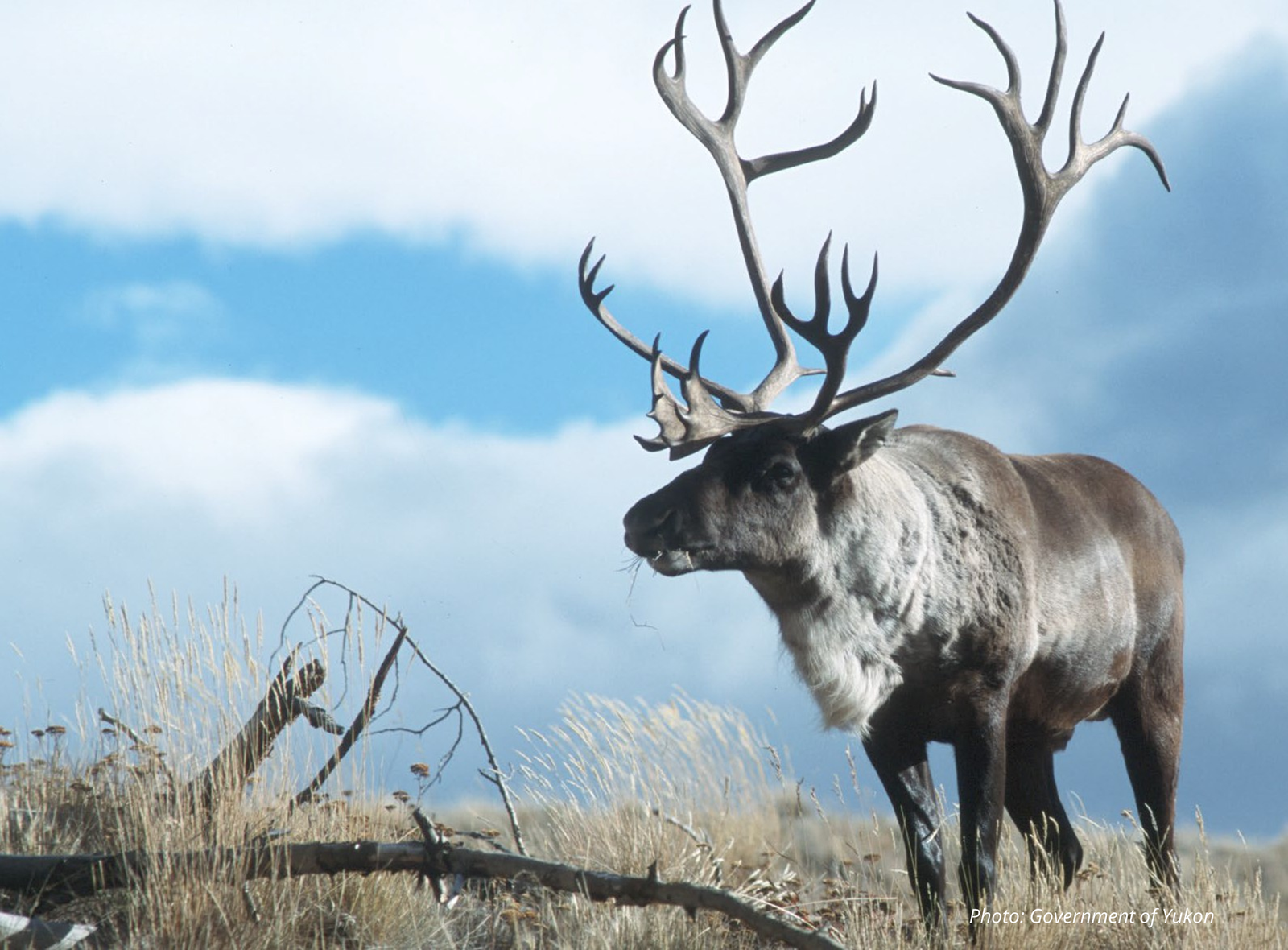
5.3.4 Caribou / Wëdzey
Caribou hold immense value from ecological and socio-cultural perspectives for the Tr’ondëk Hwëch’in and the people of the Region at large. Caribou serve as both indicator and umbrella species, making them ecologically significant in northern landscapes. As an indicator species, their health reflects the overall condition of boreal and alpine ecosystems: they are sensitive to changes in habitat quality, climate, and human disturbance, so declines in caribou populations often signal broader environmental stress.
As an umbrella species, conserving caribou habitat, especially large, intact areas, also protects a wide range of other species that share these ecosystems. This dual role makes caribou a focal point for conservation planning, guiding efforts that benefit entire ecological communities.
There are six caribou herds that live in or travel through the Region, and they can be grouped into three ecotypes:
- Porcupine Caribou Herd (barren-ground ecotype).
- Fortymile and Nelchina herds (migratory ecotype).
- Clear Creek, Hart River, and Klaza herds (woodland ecotype).
The combined ranges of all caribou herds cover nearly the entire Region and extend into other areas of the Yukon and into Alaska. The transboundary nature of caribou migration (international, across traditional territories, and between Canadian jurisdictions) poses unique planning challenges.
Much of the habitat of the Porcupine Caribou Herd in the Region is protected by SMA designations, which is why there is no barren-ground caribou overlay.
Migratory caribou have large numbers, large home ranges, and extensive seasonal migrations between their calving, summer, and winter ranges. Both the Fortymile and Nelchina herds have expansive home ranges that extend into Alaska. Movement between seasonal habitats plays a crucial role in the survival of migratory caribou.
Alpine summer habitat provides important food sources and offers refuge from predation and pests such as flies and mosquitoes. These conditions are particularly important for the survival of nursing cows and their calves. Winter habitat has essential forage and shelter from extreme cold and wind, helping caribou conserve energy and avoid predation during the harshest months. Migration corridors connect seasonal ranges.
Woodland caribou have adapted to treed, mountainous ranges, where they can feed on lichens on the ground and in the trees. Their calving, summer, and rutting ranges are all in the alpine, where they can access rich forage and avoid predation and pests. In winter, they generally reside in subalpine old-growth forests, relying on lichens on trees as their primary source of nutrition in the harsh climate. Caribou are generally dispersed across their home range for most of the year and only congregate within ancestral rutting ranges in the fall.
All caribou herds face the same threats: human-caused disturbances (such as roads, development projects, and climate change via changes to food availability). The cumulative impacts of these threats reduce herds’ resilience to ongoing changes, especially when coupled with natural fluctuations in herd sizes. Climate change has a direct effect on caribou habitat (for example, changes to forest cover, increased wildfire occurrence and severity, shifts in pathogen distribution), and will likely reduce caribou range by affecting quality, extent, and location of suitable caribou range in the future. Changing temperatures and precipitation may also impact caribou demographics – for example calf recruitment and adult female survival.
Reducing the impact of human-caused disturbances in caribou habitat will give them more space to adapt to climate change, thereby increasing their chances of survival. While caribou populations may never return to their historic levels, we can help support recovery and bring them closer to a sustainable population for future generations.
Key Planning Issues
- The Fortymile herd is the primary herd of concern in the Region, given that they face current and future conflict with certain land uses. Winter range for the Fortymile caribou herd is abundant in the Region, but caribou use of this habitat is difficult to predict from year to year. Conversely, summer ranges and migratory pathways are well known and more consistent year to year. These areas are essential to the herd’s persistence.
- The Committee on the Status of Endangered Wildlife in Canada has recommended that Barren-ground caribou (including the Porcupine Caribou Herd) be listed as Threatened. The process to list the population under the Species at Risk Act is still ongoing. If listed, a national recovery strategy would be developed, including defining critical habitat (habitat that is necessary for herd survival or recovery).
- Infrastructure like highways and industrial activity, including mining, can overlap with key migration routes and ridges, and create barriers to migration.
- Many factors may cause range use to change over time, including climate change, natural processes, and human activities. Managers must apply a high degree of caution in harvest and management strategies for all herds and herd ranges, consistent with the precautionary principle.
- Herds have different habitat needs and sensitivities at different times of year, associated with different behaviours. For example, rut (approximately September 15 to October 20) is a sensitive period for woodland herds.
- As the climate changes, caribou will be exposed to variable winters with a higher frequency of freeze-thaw events and variable snow depth, which can negatively affect populations.
- Changes to winter habitat, including lichen removal, wildfire, and the creation of permanent structures, may result in changing patterns of use over time.
- All herds face increased harvest near roads.
Goals
- Caribou herds are healthy and resilient, and their populations grow towards historic levels.
- Caribou habitat and migration pathways are sufficient to support historic population levels.
- Society respects and stays connected to caribou.
Stewardship Directions
Caribou herds need to be managed at scales that reflect their biological realities, such as their herd ranges and seasonal use areas, rather than boundaries created for other purposes, such as LMUs. Each ecotype has unique seasonal movements and habitat needs, so a one-size-fits-all approach can overlook critical ecological differences. Managing at the herd scale ensures that actions are ecologically meaningful, and it allows for more effective recovery strategies, monitoring, and collaboration between governments, industries, and other land users.
For these reasons, there are four groups of stewardship and management directions for caribou in the Region that apply:
- Region-wide.
- In the Summer Habitat Overlay – Migratory Caribou.
- In the Winter Habitat Overlay – Migratory Caribou.
- In the Woodland Caribou Overlay.
Important caribou habitat and industrial activities often overlap. These overlays are not intended to stop industrial activities; they are designed to ensure that caribou habitat can be protected while generally allowing for industrial activity. Each overlay is specific to the caribou herd(s) and to the habitat type.
Region-wide Directions
Stewardship Directions
- Treat caribou with care and respect.
- When engaging in activities on the land, follow safe operating distances from caribou as determined during assessment and regulatory processes, and as advised by the appropriate and qualified staff within the Parties.
- Promote storytelling and teachings that highlight our relationships and interconnectedness with caribou.
Implementation Actions
- Continue to support and implement, as appropriate, the Fortymile Caribou Harvest Management Plan, the Porcupine Caribou Harvest Management Plan, the Northern Mountain Caribou Management Plan, and other plans relevant to herds in the Region to ensure survival of the herds for current and future generations. Where possible, the Parties should provide sustained support and strategic coordination to ensure these plans are completed in a timely manner and achieve their intended outcomes. Once completed, the Parties should implement the management guidelines into assessment and regulatory processes.
- Carry out and support ongoing monitoring of caribou herd migration, range use, and habitat choice. Monitor climate variables and industrial activities alongside this work.
- Building on the initial lichen cover indicator, develop and implement further caribou-specific cumulative effects indicators that would apply in each overlay.
- Develop a caribou movement alert system based on collared caribou to maximize efficiency and compliance for project proponents.
Per Implementation Action 1, start work on cumulative effects indicators and related elements for this value by the end of year two.
Governance Recommendations
-
Consider climate-driven shifts in habitat requirements for all caribou herds during project assessment, policy and legislation development and Plan Review. This will help ensure the Plan and its implementation remains true to the caribou goals.
-
Develop, finalize, and, as required, implement international agreements on caribou that cross international boundaries. These include the Fortymile herd, for which the Fortymile caribou herd Harvest Plan (2025 to 2030) exists, and the Porcupine herd, which would benefit from an international agreement.
Knowledge Gaps
-
Improve understanding of caribou–industry interactions, including monitoring and assessing changes to migration patterns and habitat use in response to industrial development activity and cumulative habitat alteration – for example, development, fire, climate shifts. Research should be long term to account for changes in industrial activity over time.
- Undertake habitat modelling to assess the potential effects of natural processes and climate change (for example, increased precipitation, temperatures, and fire activity) on the primary forage species (lichen) for caribou. This work should focus on how these changes affect the quality, extent, and location of lichen.
-
Determine the availability and suitability of habitat for Porcupine caribou within LMU 2: Horseshoe.
Migratory Caribou Overlays
The overlays are intended to support the protection and recovery of the migratory caribou herds in the Region. While these herds are distinct in origin and movement patterns, they have a large overlap in habitat and share similar ecological needs. They rely on high-elevation terrain and lichen-rich forage, and can therefore be managed with a shared overlay. There are two migratory caribou overlays, summer habitat and winter habitat, which cover different habitats and have different sets of directions. For clarity, both apply year-round.
Summer Habitat Overlay – Migratory Caribou
This overlay encompasses areas identified as critical for the Fortymile caribou herd’s movement, summer foraging, and calf survival (Figure 10). This overlay also covers a large portion of the Nelchina herd’s range in the Yukon. This overlay applies year-round, to protect summer habitat and migration routes even when caribou are not present. Stewardship Directions for this overlay guide access, restoration, and land use with a strong emphasis on habitat protection.
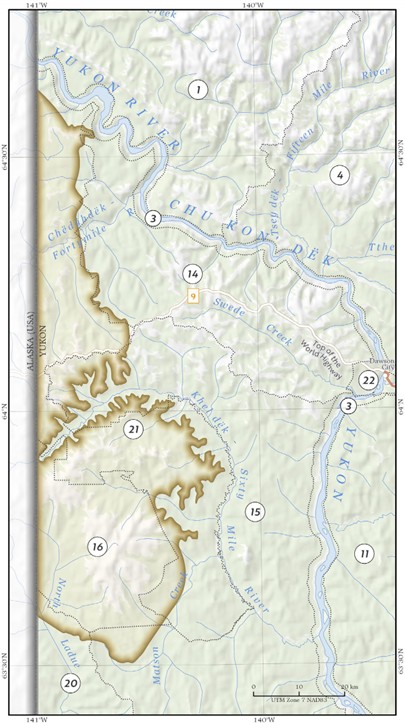
Figure 10: Summer Habitat Overlay – Migratory Caribou. This overlay covers areas identified as critical for the Fortymile caribou herds movement, summer foraging, and calf survival. This overlay also includes a large portion of the Nelchina’s herd range in the Yukon. This overlay applies year-round.
Stewardship Directions
- New quartz staking and exploration
- Quartz staking and quartz exploration outside of existing tenure are prohibited.
- Infrastructure
- No permanent infrastructure allowed above 700 m unless explicitly permitted jointly by the Parties.
- Ground disturbance
- Large patches of caribou lichens on the ground are not to be disturbed. Limit the footprint of disturbance to the smallest possible area.
- All activities
- Minimize and mitigate the effects of all direct and indirect impacts on caribou and their habitat. All methods should be low impact both to the land and to the caribou.
- Existing quartz tenure
- Quartz exploration and mining are not supported throughout the overlay, including on existing tenure.
- Offsetting
- To offset damage to caribou habitat, all efforts should be made to reclaim existing trails and trenches.
- New access
- No new access is allowed outside of existing tenure unless jointly approved by both Parties. If approved, advanced exploration or a new mine would require a project access plan.
- Existing access
- Existing access should be controlled and used only by rights holders.
- Off-road vehicles
- Restrict off-road vehicle use to existing trails.
- Caribou presence
- All activities must stop when caribou are in the area. Operators will be given advance notice when caribou are close in order to prepare to stop work.
- Restoration work
- Preferred timing: late summer to early fall to minimize disturbance. All restoration activities must aim to re-establish functional caribou habitat. In particular, caribou forage lichens and important willows (for example, Salix pulchra) should not be disturbed.
- Habitat fragmentation should be avoided. Corridors between habitat patches should be a high priority for restoration activities.
Implementation Actions
- Apply lichen cover as a cumulative effects indicator within this overlay. A single threshold is set at 80% of lichen cover within the overlay (measured as of March 2026). If this threshold is crossed (that is, cover decreases by 20%), jointly review and revise overlay directions with a goal of providing increased protection for caribou to compensate for the loss of forage.
- Increase public availability of herd data, including seasonal movement patterns and population trends.
- Update herd data annually and make it accessible through a public portal.
- At each Plan Review, re-evaluate the Summer Habitat – Migratory Caribou Overlay with consideration to:
- The effectiveness of current management directions.
- New ecological data, including lichen cover data.
- Feedback from communities and stakeholders.
- Climate change impacts.
- Wildfire events.
- Trends or significant shifts in herd movement or population dynamics.
Knowledge Gaps
-
There are no established methods for revegetating caribou lichens in the Region’s environments. Research and test potential methods, focusing on revegetation after fire and human disturbance.
-
Increase understanding of how wildfires affect caribou habitat and herd movement, and integrate wildfire data into future overlay updates.
Winter Habitat Overlay – Migratory Caribou
This overlay covers all mapped key winter habitat for the Fortymile caribou herd in the Region (excluding within the Summer Habitat Overlay – Migratory Caribou and the Woodland Caribou Overlay). This overlay applies year-round to protect winter habitat even when caribou are not present (Figure 11). Stewardship Directions for this overlay focus on achieving no net loss of functional caribou habitat.
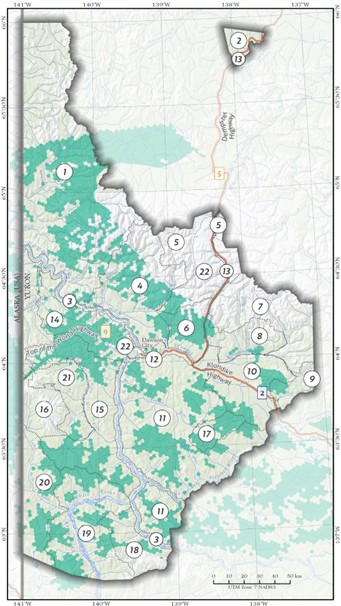
Figure 11: Winter Habitat – Migratory Caribou Overlay. This overlay covers all mapped key winter habitat for the Fortymile caribou herd in the Region (excluding within the Summer Habitat – Migratory Caribou Overlay and the Woodland Caribou Overlay). This overlay applies year-round.
Stewardship Directions
- When proposing development (subject to YESAB assessment) within this overlay (with the exception of placer mining below 700 m), apply the mitigation hierarchy with the goal of no net loss of functional caribou habitat. The Plan encourages working toward a net gain of functional caribou habitat. Proponents must respond directly to the mitigation hierarchy. This structured approach prioritizes ecological integrity and caribou habitat are prioritized. An example of the Mitigation Hierarchy Response Form is in Appendix 7.
Mitigation Hierarchy
- Avoid: Activities should be avoided entirely in this overlay. If projects must occur, proponents must demonstrate how they are avoiding high-quality habitat patches by showing the locations of proposed targets, access, camps, and so on, in relation to mapped caribou habitat.
- Minimize: Proponents must:
- Use low-impact methods.
- Limit footprint and duration of activities.
- Avoid sensitive seasons.
- Minimize and mitigate the effects of all direct and indirect impacts on caribou and their habitat.
- Record and communicate all caribou observations.
- Restore: All disturbed areas must be restored to functional caribou habitat (Section 3.11).
- Offset: Until such time that additional beneficial offsets are described, offsets should focus on restoring trails and trenches.
Implementation Actions
- Ensure all project proposals within the Winter Habitat – Migratory Caribou Overlay include a mitigation hierarchy assessment. Develop, publicize and apply review criteria to evaluate whether avoidance and minimization have been adequately pursued.
- Apply lichen cover as a cumulative effects indicator within this overlay. A single threshold is 80% of lichen cover within the overlay (measured as of March 2026). If this threshold is crossed (that is, cover decreases by 20%), jointly review and revise overlay directions with a goal of providing increased protection for caribou to compensate for the loss of forage.
- Maintain a public registry of restoration and offset activities, including monitoring results.
- Adapt mitigation expectations over time, based on herd data and ecological outcomes.
Woodland Caribou Overlay
The Woodland Caribou Overlay encompasses the ranges of three distinct herds: Clear Creek, Klaza, and Hart River (Figure 12). While each herd occupies a unique landscape, they share similar ecological characteristics and vulnerabilities, allowing for a unified management framework. This overlay guides land use and restoration activities to support the long-term health of woodland caribou populations.
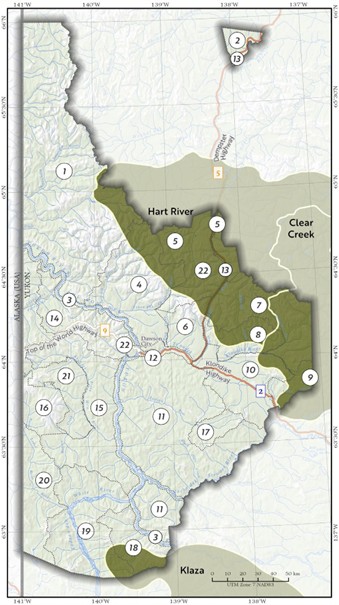
Figure 12: Woodland Caribou Overlay. This overlay covers the range of three distinct herds in the Region: the Clear Creek, Klaza, and Hart River herds, which all share similar ecological characteristics and vulnerabilities. The overlay applies year-round.
Stewardship Directions
- Alpine Protection
- No exploration is allowed in identified rutting areas from September 15 to October 15.
- Use of Existing Roads
- Roads in mapped rut habitat cannot be used during rut (September 15 to October 15).
- Winter Access
- No winter access (November 15 to February 28) except for trapping and recreation.
- Road Construction
- No new roads before the Na-Cho Nyäk Dun Regional Land Use Plan is complete. After it is complete, Tr’ondëk Hwëch’in, Na-cho Nyäk Dun, the Government of Yukon, and both Commissions should revisit this direction together.
- Road Construction
- No loop roads.
- Lichen Conservation
- The overlay remains a high priority for wildfire fighting, especially the winter range portion.
- Reclamation
- Reclamation must occur in both alpine and valley-bottom areas, with habitat-specific goals.
- Monitoring Requirement
- Proponents must complete annual habitat condition assessments.
- Mitigation Hierarchy
- Demonstrate how the project adheres to the mitigation hierarchy. Specifically:
- Avoid: Show that the proposed project avoids key mapped habitat for caribou and, where the data exist, high-quality patches of caribou forage. Provide specific details about where all parts of this project will be located, including the main activities, access, and camps.
Implementation Actions
- Increase understanding of how wildfires affect caribou habitat and herd movement. Integrate wildfire data into future overlay updates.
- Apply lichen cover as a cumulative effects indicator within this overlay. A single threshold is set at 80% of lichen cover within the overlay (measured as of March 2026). If this threshold is crossed (that is, cover decreases by 20%), jointly review and revise overlay directions. The goal is to provide increased protection for caribou to compensate for the loss of forage.
- Develop a cross-regional plan for the Clear Creek herd range that involves:
- The Commissions and Parties from the Dawson, Peel, and Na-Cho Nyäk Dun Regional Land Use Plans.
- Shared data, restoration goals, and access protocols.
- Continue to apply findings from the existing Clear Creek Range Assessment.
- Provide resources and coordination for the upcoming Hart River Range Assessment.
- Use assessment results to refine Woodland Caribou Overlay boundaries and management directions, if required, during Plan Review.
- Ensure restoration outcomes are habitat-specific and monitored for effectiveness.
- Maintain a public registry of restoration activities and outcomes.
- Include restoration performance in Plan Review.