
5.3.6 Landscapes
All the Region’s landscapes have inherent value in their own right. They hold and connect ecosystems and viewscapes, provide homes for wildlife, and provide many services to people. Connectivity between habitats and ecosystems is essential. Many species rely on the ability to move freely across landscapes to find food, reproduce, and adapt to changing conditions. Fragmentation of habitats can isolate populations, reduce genetic diversity, and increase vulnerability to environmental stressors. Maintaining and restoring ecological connectivity supports biodiversity and strengthens ecosystem resilience.
This resilience is important to all communities, including human communities. Resilient ecosystems support wildlife populations for us to harvest, mitigate floods, and protect our drinking water. Maintaining intact landscapes is a long-term, holistic way to protect future generations and our non-human relations. Landscapes also provide the foundation for ecosystem services – such as clean water, carbon storage, and biodiversity – that are essential for sustaining life and supporting communities.
Forests
The boreal forest, which traverses North America from Alaska to Newfoundland and Labrador, covers most of the Region. Forests support high levels of biodiversity and are habitats for many of the Region’s animal populations. Forests also provide opportunities like birch sap for syrup; chaga and morel mushrooms; non-commercial harvesting of personal fuelwood and timber; and hunting, fishing, and trapping.
The boreal forest is adapted to regular wildfire, which is, in fact, an important part of the ecosystem. However, ongoing climate change means that fires occur more frequently and burn hotter, which can have significant negative impacts on the forests and the species that live within them. Wildfires can also pose a significant threat to infrastructure and community well-being. The Dawson City Community Wildfire Protection Plan provides a wildfire risk management strategy and tools for increasing resilience to wildfire for Dawson City and the surrounding areas. There are also numerous pests and diseases which threaten forests throughout the Region, though, currently, these threats occur at relatively low numbers.
You don’t dig into the earth more than trail deep.
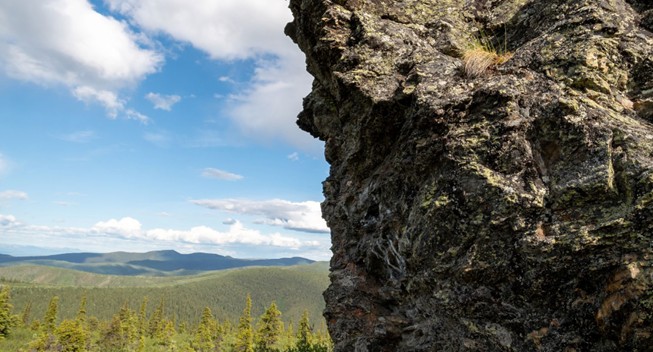
Photo: Government of Yukon
Mountains
Mountain ecosystems are vital ecological and cultural landscapes. They play a key role in the health and resilience of the broader environment. As the source of major headwaters, these high-elevation areas feed critical river systems that support biodiversity, sustain downstream communities, and maintain hydrological balance across the Region. Their steep slopes and varied elevations create many microclimates.
These conditions make mountains important climate refuges. They offer sanctuary for species under pressure from warming temperatures and contribute to overall ecosystem resilience. Mountains shape vegetation patterns, soil development, and wildlife habitat. In doing so, they contribute to the Region’s ecological richness and complexity.
Beyond their ecological significance, mountain areas hold deep spiritual and cultural meaning for Indigenous communities. These communities have long relied on them as landmarks and for traditional use, including hunting, gathering, and ceremonial practices. These landscapes are woven into stories, teachings, and seasonal cycles, and reflect a strong connection between people and place. The mountains also offer recreational opportunities that foster appreciation and stewardship. They draw residents and visitors for hiking, wildlife viewing, and solitude.
Beringia
During the Last Glacial Maximum (~26,500 to 15,000 years ago), much of the Region lay within an ice-free area known as Beringia. Animal and plant populations survived in Beringia when ice sheets covered most of Canada. As glaciers retreated, populations from Beringia expanded into the newly available habitats. Many common North American plant species likely originated in Beringia and later spread across the continent.
Beringia’s value is not just historical. Some of these plants and animals never moved very far, which makes Beringia a hotspot for endemic vascular plants and a significant contributor to Canada’s vascular plant diversity. Beringia is also home to endemic animals like the collared lemming and a number of insects (see also Section 5.3.2).
Tundra
Tundra landscapes have long supported plants and wildlife uniquely adapted to harsh conditions. They act as reservoirs of biodiversity and as natural carbon sinks that have helped stabilize the global climate. Today, tundra landscapes remain vital for regulating the climate by storing significant amounts of carbon in permafrost. They also provide habitat for specialized species, sustain cultural traditions, and support scientific research on climate change.
Tundra areas offer striking viewscapes and unique recreational opportunities, from hiking and wildlife viewing to experiencing vast, open horizons that foster a sense of connection to nature. Looking ahead, as warming accelerates, tundra ecosystems will play a pivotal role in global carbon dynamics. Their preservation is essential to limit greenhouse gas release, maintain biodiversity, and protect cultural heritage in rapidly changing environments.
Wetlands
Wetlands are important landscapes in the Region. Because of their ecological, cultural, and industrial significance, they have their own Stewardship Directions (Section 5.3.7).
Key Planning Issues
- Infrastructure, including roads, development and resource extraction activities, can lead to habitat fragmentation.
- Increasing frequency and intensity of wildfires due to climate change threatens the integrity of forest ecosystems.
- Connected landscapes support ecosystem and population resilience.
- Protecting climate refugia contributes to species resilience.
- Competing land interests require balancing biodiversity conservation with forest harvesting.
- Alpine and headwater ecosystems are vulnerable to climate change and human disturbance.
- Endemic species are vulnerable to disturbance and habitat loss.
Goals
- Landscapes are appreciated for their inherent value.
- Viewscapes are maintained, especially when they are of community or cultural significance.
- Critical, rare, or unique ecosystems are preserved, while recognizing that some ecosystems are likely to shift due to climate change.
- Connected landscapes support resilient ecosystems and plant and animal populations.
Stewardship Directions
- Treat the land with humility and respect, recognizing your role as a caretaker rather than an owner.
- Avoid or minimize disturbance in rare habitats and ecosystems, including steppe, riparian areas, and old-growth forests.
- Incorporate ecosystem- or landscape-specific climate risk and mitigation and adaptation measures in development applications.
- Identify and document rare habitats and ecosystems in the project area before submitting a project for assessment.
- When proposing and developing projects, do not create disturbances in Wildlife Key Areas (WKAs). Do not disturb mineral licks identified by the Government of Yukon and made publicly available.
- When proposing and developing projects, consider connectivity within and between landscapes, and make best efforts to retain connectivity.
Implementation Actions
- Update mapping of both human-caused and natural disturbances, including wildfire, permafrost thaw, and forest pests.
- Maintain and restore corridors for wildlife movement across landscapes. Prioritize connectivity in zoning and restoration efforts, especially between forested areas, alpine zones, and wetlands.
- Prioritize protecting headwater areas.
- Prioritize identifying and protecting climate refugia for culturally and ecologically important species, for species most at risk from climate change.
Governance Recommendations
-
Incentivize protecting areas with underlying permafrost.
Knowledge Gaps
- Observe and monitor changes to rare species and ecosystems, particularly low-elevation steppe meadows and alpine areas.
- Identify areas of climate refugia and develop plans to protect these areas.
- Develop specific research initiatives to increase understanding of permafrost in the Region, including the following:
- Identify high-risk areas for permafrost thaw.
- Assess the impacts of permafrost thaw on local biophysical conditions, including water quality and availability, flow, and wetlands.
- Measure emissions of greenhouse gases, heavy metals, and diseases associated with permafrost thaw.
- Develop appropriate and effective mitigation measures to minimized permafrost thaw from resource and road development projects.
- Explore techniques for encouraging the re-establishment of permafrost.
- Geohazard mapping and permafrost studies along highway corridors.