5.4.1 Sustainable Local Economy
Economies should not be separate from health, we must reimagine how economies function so they reinforce our stewardship relationship with the land, rather than fight against it.
The Sustainable Local Economy envisioned for the Region will provide sufficient economic resources for residents without harming other values. It will circulate wealth within the community, and be resilient by relying on diverse activities. Economies include the harvest, production, and distribution of goods and services, many of which ultimately come from the land. In recognition of this reliance, the Plan advocates humility.
“Economic” does not necessarily involve money; for example, harvesting fuelwood or hunting are economic activities. In the sections that follow, the Plan speaks to activities that are directly reliant on, and/or significantly affect the land, and recognizes two kinds of sustainable economic activities (Section 2.2.1): those that do not degrade the land or undermine communities, and those that deplete resources, but from which the land can recover. Robust and ongoing reclamation ensures that the integrity of the Region’s landscapes is maintained. In this way, they will be able to continue to support the community’s needs into the future.
To be sustainable, the economy must be profitable, because profitability ensures that businesses can reinvest in operations, support employment, and fund innovation. Without economic viability, environmental and social goals cannot endure over the long term, as financial instability undermines the capacity to implement sustainable practices.
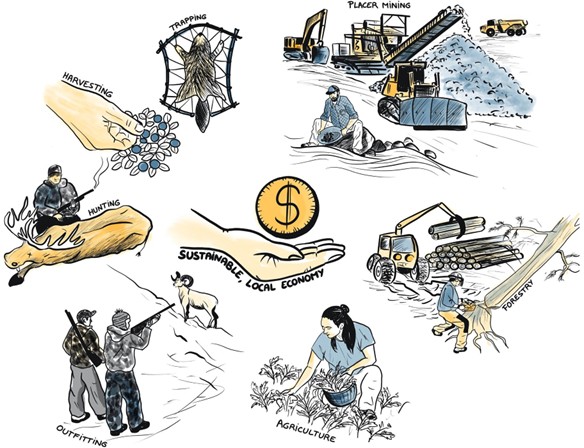
Artwork: Yukon Graphic Recording ©2025
Not only does the traditional economy provide a lifestyle and economic benefit to those who are involved, the activity is rooted in stewardship […] it provides a necessary tool to facilitate the teaching and passing on of Traditional Knowledge to the younger generations of all Yukoners.
The Tr’ondëk Hwëch’in have practised a traditional economy in the Region since time immemorial, and its modern version is part of the Region’s broader economy. “Traditional” does not mean “old” or “out of use”. Rather, it refers to practices that are “based on traditions and customs in keeping with the ancestral values of stewardship of the land and its natural resources”. Traditional economic activities provide both tangible (for example, meat, fuelwood, income from selling trapped fur) and intangible benefits (for example, cultural and social well-being, intergenerational knowledge transfer).
Healthy environments and wildlife are essential to the traditional economy. Changes to the land (for example, from development pressure, human activity and climate change) affect Tr’ondëk Hwëch’in Citizens’ ability to practise these economic activities, a recognized right under UNDRIP. While traditional economic activities are part of Tr’ondëk Hwëch’in’s living heritage, many non-Indigenous residents also take part in these types of activities, which contribute to community stewardship and connection to land while providing for their own needs. Food harvested from the land is important to physical health and reduces reliance on costly and carbon-intensive imported food. The Plan envisions a thriving traditional economy as an integral part of the Region’s Sustainable Local Economy into the future.
Indigenous Peoples have the right to maintain and develop their political, economic and social systems or institutions, to be secure in the enjoyment of their own means of subsistence and development, and to engage freely in all their traditional and other economic activities.
- Sustainable population growth.
- Local benefits from major development projects.
- Year-round business and employment base.
- Sustainable, well-paying jobs.
- A diverse economic base.
- Available and affordable housing.
- Quality infrastructure.
- Attractive quality of life.
The REDP provided a six-year timeframe for completing the initial initiatives, with provisions for revision every five years or when Tr’ondëk Hwëch’in, the Government of Yukon, and the Government of Canada see fit. This review has not been completed at the time of writing.
The benefits people gain from employment (financial resources, a sense of contribution and belonging, the ability to gain and use skills and knowledge) are similar across sectors, though each sector has its own required skillset and culture. The combination of activities that contribute to the local economy is influenced by factors inside and outside the Region and changes over time.
In response to this variability, a selection of current and potential land-based economic activities is included as subsections of this value, with specific management directions where warranted (this list is not exhaustive). People engaged in any economic activity should also read the rest of Section 5: Management Directions, as the Stewardship Directions associated with each value apply to all land users.
The Plan’s reclamation-related directions are a second response to anticipated change, especially as a way to mitigate impacts of boom-and-bust resource sectors like mining. When land-based projects include ongoing reclamation and reclamation planning from the beginning, they can provide consistent long-term employment that remains if an industry down-cycles. A third way the Plan responds to the dynamic nature of economic sectors is to encourage policy and programs that support local cross-training and skills transfer across industries.
By following the Plan, the Parties will guide overall economic system change towards Plan goals. A resilient local economy will be able to continue to sustain quality of life in the Region even as different activities come and go. By focusing management directions on the value of Sustainable Local Economy, as opposed to a specific combination of activities, the Plan builds in resilience and adaptive capacity.
The economic activity sections that follow contain activity-specific directions to protect other values and directions to encourage the sustainable pursuit of the activity. The activities are split into current and future potential activities, though the lists are by no means exhaustive.
| Sustainable Local Economy Activities | |
|---|---|
| Current | Potential |
| Tourism | Quartz Mining |
| Outfitting | Oil and Gas |
| Trapping | Fishing |
| Forestry | Renewable Energy |
| Agriculture | |
| Mineral Exploration | |
| Placer Mining | |
Key Planning Issues
- Many of the Region’s residents rely on land-based economic activities to meet their needs.
- Land-based economic activities are not necessarily compatible with one another.
- Many economic activities can negatively impact the Region’s values.
- Practising traditional economic activities is vital to Tr’ondëk Hwëch’in culture and individual and community well-being. This requires healthy wildlife and land, opportunity, and access.
- Access for any economic activity (traditional, industrial, commercial) can negatively affect land and wildlife.
- Land users engaged in different economic activities have different priorities and values, and are governed by different, sometimes conflicting, regulations.
- Many of the Region’s economic activities depend on external factors – for example, global travel trends and resource prices.
Goals
- The Region’s economy is diverse and resilient, centred on the local community and responsive to its needs, and composed of sustainable economic activities.
- There is significant participation in a thriving, varied traditional economy.
- The Region has a robust renewable resources economy (after THFA 16.1.1.2).
- Tr’ondëk Hwëch’in Citizens’ traditional uses of the land, which are constitutionally protected, are respected and supported throughout the Region, and not negatively impacted by other economic activities.
- Many locally owned and operated businesses are successful and provide local employment.
- All land-based economic projects in the Region provide benefits to the local community and residents that collectively outweigh any negative impacts to the Region’s values.
- Economic activities that benefit multiple Plan values are supported in favour of those that require trade-offs.
- There is room and encouragement for new economic sectors within the Region’s economy.
- To limit risk and provide consistent, long term benefits, smaller-scale and longer time frame projects are prioritized over large-scale and short time frame projects.
Stewardship Directions
- Be considerate of other land uses and communicate in advance with other land users when planning and engaging in economic activities on the land.
- When planning and proposing projects, give special consideration to traditional economic activities that overlap with or could be affected by the project, including trapping and harvesting.
- When proposing and considering Class 4 advanced exploration and mining projects, include traditional use impact studies and show how the project applies the mitigation hierarchy to traditional economy values.
- Include climate change vulnerability assessments and measures for mitigation and adaptation when planning and proposing projects and activities.
- Source materials and hire locally whenever possible.
- Plan and undertake economic projects and activities in a way that:
- Minimizes waste of energy and resources.
- Minimizes carbon emissions.
- Contributes to industry or sector improvements – for example, optimizing novel technologies.
- Incorporates reclamation where values are negatively impacted.
- Incorporates local and Traditional Knowledge.
Implementation Actions
- Support community-based research and monitoring, including annual surveys that gather knowledge from people accessing the land for harvest activities – for example, those carried out by Tr’ondëk Hwëch’in and the Dawson District Renewable Resource Council.
- Use local knowledge, including that gathered through harvest surveys, into decision-making and Plan Review.
- Promote local employment, skills development and cross-training, and support programs that contribute to these opportunities.
- Explore and promote sustainable economic opportunities that result from climate change – for example, new agricultural possibilities.
- Explore and promote sustainable economic opportunities that contribute to climate change mitigation and resilience – for example, renewable energy infrastructure, carbon credits, building local capacity to respond to emergencies, increasing food security.
- Promote and incentivize economic activities that benefit multiple values and meet the Plan’s definition of sustainable activities.
Per Implementation Action 1, start work on cumulative effects indicators and related elements for this value by the end of year four.
Governance Recommendations
- Review and revise the Regional Economic Development Plan for the Tr’ondëk Hwëch’in Traditional Territory so that new initiatives align with Plan goals and directions.
- Continue to explore and support collaboration where multiple interests and rights exist, such as through the development of formal multi-use arrangements between land users – for example, miners, foresters and farmers.
- Preserve key use areas, infrastructure, and resources that support traditional economic activities, and develop them further where required.
- During project assessment, require traditional use impact studies from proponents of Class 4 exploration and mining projects.
Knowledge Gaps
-
There is limited information on the impacts of development on traditional economic pursuits in the Region. There is also limited information on what buffers or other tools would be sufficient to protect these activities and the lands and ecosystems they depend on. Research zones of influence and direct impacts of industries most likely to affect traditional economic activities and areas of high traditional economy value – for example, those identified in Ninänkäk hǫzǫ wëk’ä̀tr’ëǹ òhcha: We Take Good Care of Our Land.
- Land use patterns associated with trapping and other traditional economic activities, including locations of cabins and trails, are not well documented. Research and document this land use, as well as ways this information can inform project assessment and planning, with care for confidential or sensitive information.