Placer Mining
Placer mining has always been a vital part of the community of Dawson City as well as the greater Yukon. We are an industry that has endured the ups and downs alongside our communities and territory as a whole, and we want this to continue into the future.
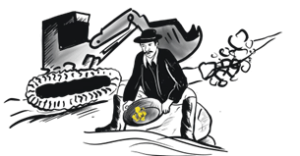 Placer mining is the extraction of minerals from loose deposits, such as sand and gravel, found above bedrock. In the Yukon, placer mining generally targets gold deposits that range in size from very fine grains to nuggets. Placer gold is separated from sediments using only water and gravity. A sustainable placer industry creates wealth and opportunity for the Region, while stewarding the land through responsible practices such as progressive reclamation.
People first discovered gold in Bonanza Creek in 1896. Days later, the Klondike Gold Rush was in full swing, with creeks staked and mined from end to end. This led to the establishment of Dawson City and the creation of the Yukon as a distinct Canadian territory, the displacement of the Tr’ondëk Hwëch’in, and damage to their lands. By 1899, the gold rush had declined as easily accessible deposits decreased, and gold was discovered in Alaska. Although many miners moved out of the Region, the social, environmental, economic, and cultural impacts of the gold rush remained, reshaping the Region and Tr’ondëk Hwëch’in’s way of life. Today, placer mining remains an important part of the Region’s economy, with many residents, including Tr’ondëk Hwëch’in Citizens, continuing to work in the industry and/or own operations.
Placer mining often involves washing sediments from permafrost, and miners sometimes unearth ancient remains of animals. One such find happened in 2022, when miners working on Eureka Creek in the Goldfields discovered a mummified baby woolly mammoth. The miners stopped work and immediately notified Tr’ondëk Hwëch’in. Elders travelled to the site and recognized not only a chance to learn about past ecosystems, but a relative. They carried out ceremony, blessed the site and the mammoth, and moved her safely to the community with the help of the miners and Government of Yukon staff. The miners continued working the creek and continue to be involved in the story of the mammoth. Tr’ondëk Hwëch’in leads the care of Nun cho ga (big animal baby), who continues to offer teachings on what the land and plants were like at the time of her death, 36,000 years ago, and on ancestral relationships and healing.
The remoteness of many placer mines, and limited compliance inspections, make it easy for miners to keep remains privately or to simply continue work, burying a find as they move materials around, despite regulations and best practices dictating otherwise. The story of Nun cho ga illustrates what can happen when trust and relationships exist among industry and the community. It also shows how one act of trust can build relationships. A truly Sustainable Local Economy requires industry practitioners with strong community relationships.
In addition to newly discovered deposits, technological advances have allowed miners to process previously mined areas and refine gold more effectively and efficiently. In 2024, the Dawson Mining District, which covers most of the Region, was the most active placer mining district in the Yukon, accounting for 70% of all active operations. Within the Region, the Indian River, Sixty Mile River, and Dominion Creek were the highest-producing drainages. In 2025, there were 111 actively sluicing operations in the Dawson Region.
Placer mining extends beyond just an economic activity – it is deeply rooted in the Region’s culture and identity. The tradition of placer mining is often passed down through families, which helps build a strong sense of pride and connection to the Region. Between 2020 and 2022, the majority of placer miners in the Region worked with or employed family members, and over half were second- or third-generation placer miners.
Operations also contribute to the community by supporting local businesses, employing and training locals, and through sponsorships and in-kind donations. Placer miners improve local infrastructure through construction and maintenance, and work with other industries, such as hard rock mining. Placer mining drives tourism in the Region, not only by attracting visitors interested in the gold rush itself, but also by drawing visitors interested in historical figures like Robert Service and Jack London. These writers came to Dawson inspired by the gold rush and have become central to the Region’s cultural history. Additionally, miners acting as stewards of the land have contributed to numerous paleontological and archaeological discoveries.
Placer mining in the Region is expected to grow due to the discovery of new deposits, technological advancements that enable miners to reprocess previously mined areas and refine gold more efficiently, and the steep increases in gold prices – for example, in 2025, the average price of gold increased by 34% from 2024. However, gold is a finite, non-renewable resource; eventually, there will be no more viable deposits. It is therefore essential to incentivize operations to build strong connections within the community, ensuring residents continue to benefit from these operations and that long-term stability is maintained throughout the life of this resource.
Placer mining must be guided by the Plan’s principles of sustainable development (Section 2.2.1), the precautionary principle (Section 2.2.3), and stewardship (Section 2.2.2), ensuring it supports the community and protects the Region’s environmental, socio-cultural, and economic values for future generations. Miners and the community must work together to ensure that mining benefits the Region without compromising its future. They must also recognize and celebrate the positive impacts of mining. One example of how the placer mining industry, the community, and the Parties can work together is through the Upper Indian River Stewardship Plan. It aims to bring people with overlapping interests together to develop innovative solutions and move forward together in a good way.
The Placer Mining Act (SY 2003, c.13) regulates placer mining in the Yukon. Operations require assessment by YESAB, water licences from the Yukon Water Board, and, depending on activities, additional permits. At the time of writing (March 2026), the successor minerals legislation that will replace the gold rush-era Placer Mining Act (SY 2003, c.13) is still in development.
To be successful, the successor legislation must align with the spirit and intent of the FNFAs. It must also reflect the Plan’s principles of sustainable development (Section 2.2.1), the precautionary principle (Section 2.2.3), and stewardship (Section 2.2.2), while focusing on protecting and strengthening the socio-cultural, environmental, and economic values of the Region. The modern legislation should also support the Region’s growing placer industry through timely, consistent, and transparent assessment and regulatory processes that encourage stewardship by recognizing and rewarding good actors. Such measures are essential for the continued success and sustainability of the industry in the Region. Directions for all values and economic activities should be read alongside the Stewardship Directions for Placer Mining because of the interconnections between values and activities.
Key Planning Issues
- A consistent, streamlined, and effective assessment and permitting process is necessary to ensure the continued success of the industry in the Region.
- Placer mining often occurs in areas of high cultural and spiritual significance and can damage heritage resources and discourage Citizens from using these areas.
- Placer mining often occurs in ecologically sensitive areas and, historically, operators have conducted it in ways that have compromised both environmental and cultural values. Many sites were left unreclaimed, which has contributed to a lasting negative legacy in the Region.
- Increases in suspended sediments resulting from placer mining are harmful to fish and fish habitat.
- Placer mining often occurs in wetlands, which have high ecological, cultural, and economic value – for example, ecosystem services. See Section 5.2.7.
- Placer mining often requires the thawing of permafrost, which can disrupt groundwater and drainage patterns.
- Existing legislation does not provide a consistent definition or process for the reclamation of placer mines.
- Regulations that manage the placer industry often disadvantage smaller operators, for example, by adding bureaucratic hurdles.
Stewardship Directions
- When operating a placer mine, carry out progressive reclamation.
- Carry out placer mining activities in a manner that respects the land, the history, and the community.
- When you discover heritage and cultural resources or paleontological artefacts, avoid negative impacts by following Best Management Practices for Fossils at Yukon Placer Mines as well as legislated requirements: Tr’ondëk Hwëch’in Heritage Act and Government of Yukon’s Historic Resources Act (RSY 2002, c.109).
- Operators should buy local and employ local workers to maximize benefits to the Region’s community.
Implementation Actions
- Encourage industry organizations that run industry-led programs such as KPMA1011 to continue providing education and to promote excellence and innovation in mining reclamation, with a goal of strengthening partnerships and building the community’s confidence in the placer mining industry.
- Support and implement training opportunities for wetland identification for miners, enforcement staff, and inspection officials.
- Review and revise administrative burdens on operators to ensure small operators can continue to participate in the industry and contribute to the Region’s Sustainable Local Economy and the community.
- Improve monitoring and compliance to ensure that mines operate responsibly, minimize environmental and social impacts, and act as stewards of the land.
- Partner with industry organizations to provide joint educational opportunities for Tr’ondëk Hwëch’in Citizens and employees of the placer industry with the aim of fostering relationships built on trust, understanding, and respect. Examples include:
- Participation of non-Citizen industry employees in TH 101 to foster understanding of Tr’ondëk Hwëch’in culture and values.
- Tours of placer operations for Citizens.
1 An app-based training and compliance education program for placer miners, created by the Klondike Placer Miners’ Association.
Governance Recommendations
- When developing and approving successor minerals legislation, ensure it aligns with the spirit and intent of the THFA.
- Improve permitting and assessment processes to be more timely, consistent, streamlined, and transparent, and to recognize and reward good actors to encourage stewardship. See Section 3.11 and Implementation Action 25.
- Work with placer miners and the community to create a plan for the future of placer mining in the Region.
Knowledge Gaps
-
Quantify the amount of carbon stored in the Region and the amount released from placer mining in wetlands.
Dawson Regional Planning Commission
Whitehorse Office
302-309 Strickland Street
Whitehorse, Yukon, Y1A 2J9
Phone: 867-667-7397 ext. 4