Quartz Mining
The failure of a quartz mine could be the single most devastating event in the Region in modern times, environmentally, socially, and economically. Nearly every quartz mine in the territory has failed in some way under the current regulatory system. Structural failures have led to environmental damage, economic failures have led to ongoing costs to Yukon taxpayers, and social failures have led to severe impacts on communities and families. The risks of quartz mining are great, even when mines are “successful”. Under the current regulatory system, and with commonly used technologies like heap leach, the potential benefits to local communities are not worth this risk. Quartz mining needs to develop trust and social license, and must be regulated much more rigorously, before it is an appropriate economic activity for this Region.
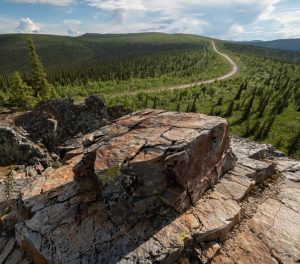
Photo: Government of Yukon
Quartz (or hard rock) mining involves extracting minerals from solid rock through large-scale operations, such as open-pit or underground mining. This often requires both chemical and mechanical processes. A common method is heap leaching, in which crushed ore is treated with chemical solutions, such as cyanide, to dissolve and recover the target minerals. Due to its geological history, the Region has significant mineral potential, with identified deposits of gold and critical minerals such as copper and antimony.
Accessing and processing these deposits can have large negative impacts on the environment even when the strongest mitigations are in place. Risks vary with scale and methods used, and only methods and technologies with proven track records in similar environments should be considered. While there are currently no active quartz mining operations in the Region, there are several exploration projects. Directions for all values and economic activities should be read alongside the Stewardship Directions for Quartz Mining because of the interconnections between values and between activities.
Quartz operations are generally large-scale, requiring significant infrastructure and a workforce, often composed largely of non-resident employees. These projects can disproportionately affect small communities. While they can bring benefits, like local employment and skills training, they can also bring negative impacts.
These impacts include increases in gender-based violence associated with male-dominated camps, increased alcohol and substance abuse and trafficking (in camp and in nearby communities). The added burden on local infrastructure, including medical and policing facilities, must also be anticipated and mitigated. Even the benefits must be managed carefully to ensure they do not lead to long-term difficulties, as can happen when a mine shuts down without a transition plan for employees, and leaves a large employment gap.
As of March 2026, the Quartz Mining Act (SY 2003, c.14), largely unchanged since the gold rush, remains the primary means of regulating quartz mining. The successor minerals legislation intended to replace this law, committed to in the Final Agreements, is still in development. For this industry to be compatible with the Plan, it will need to be regulated in accordance with the spirit and intent of the FNFA, the Plan’s principles of sustainable development (Section 2.2.1), the precautionary principle (Section 2.2.3), and stewardship (Section 2.2.2), and must safeguard and bolster the socio-cultural, environmental, and economic values of the Region.
Adequate financial security must be required to ensure the entire project lifespan, including reclamation, can be completed in alignment with Tr’ëhudè. Royalties must also be required for local governments, recognizing that operations rely on public goods, services, and infrastructure, and that other values in the Region will be affected by these operations. New legislation should also enhance safety within operations (environmental, physical, and personal).
The Plan envisions rigorous management of quartz activities, supported by a thorough regulatory system that will allow the community to benefit from quartz development without suffering from its potential negative impacts. Until this is possible, quartz mining is not compatible in this Region.
Key Planning Issues
- Common and cost-effective technologies used in quartz mining, like heap leaching, have poor record of environmental safety in northern and permafrost-rich environments.
- Yukon territorial mining legislation is outdated and insufficient to moderate the risks of quartz mining.
- Quartz operations can have large impacts on small communities.
- Current regulations are inadequate to ensure financial benefits from quartz operations flow to local communities and governments.
Stewardship Directions
- Do not engage in or approve heap leach mining in the Region under the current regulatory regime, and wait until low-risk technologies are proven in similar environments.
- When proposing and considering quartz projects, rely on low-risk technologies, and trial new or unproven technologies only at small scales and in a contained way.
Implementation Actions
- Increase the consistency and detail of monitoring at mine sites, specifically at tailing ponds, and particularly during snowmelt when they are at greater risk of failure.
- Improve standards, regulations, and enforcement to ensure that quartz mining occurs in a manner consistent with the Plan’s principles.
Governance Recommendations
-
Revise existing regulations or create new ones to better govern heap leach mining, prevent future harm to the community and the environment, and address the factors that led to previous failures.
Knowledge Gaps
-
Current common practices to extract minerals from ore bodies involve harmful chemicals that endanger ecosystems and humans. They also have poor track records of safe operation in northern and permafrost-rich areas. Research alternative methods.