
Forestry
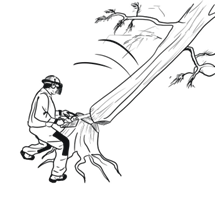
A sustainable forest industry maintains the health and productivity of forest ecosystems, conserves soil and water resources and biological diversity, and provides social and economic benefits while supporting healthy land–people relationships. With careful management and planning, the Region’s forests can sustain a vibrant, small-scale forestry industry, as well as supporting non-market harvest, non-timber uses and a traditional economy. These activities can contribute to a healthy local economy, including local employment opportunities.
The regional forestry industry includes commercial fuelwood (fire-killed spruce and green birch), biomass (wood chips), and lumber. A successful forestry industry requires a long-term wood supply that is accessible year-round and near Dawson City. The current harvest in the Region is relatively small yet stable (2,500 m3 to 3,000 m3 per year; Yukon Wood Products Association, 2019). In 2021, the governments of Tr’ondëk Hwëch’in and Yukon, together with the Dawson District Renewable Resources Council, set the annual allowable cut (maximum amount of timber that can be sustainably harvested) at 28,000 m3 per year of green timber on public land. This annual allowable cut meets objectives for forest resources for the next 10 years.
The Dawson Forest Resources Management Plan provides a framework for the sustainable management of a forest-based economy as directed by Chapter 17 of the THFA. The Forest Resources Act (SY 2008, c.15) provides a planning, tenure, compliance, and enforcement regime to support the management of forests in the Yukon. Directions for all values and economic activities should be read alongside the Stewardship Directions for Forestry, because of the interconnections between values and activities.
Key Planning Issues
- There has recently been a shortage of access to fuelwood across the Yukon, including in Dawson. The primary issue is limited access to fire-killed timber in LMU 11 during winter due to excessive ice formation on resource roads.
- Fuelwood and timber harvesting can negatively affect traditional and non-timber uses of the forest.
- Forestry activities can affect ecosystem and wildlife values, directly and through increased access.
- Riparian buffer zones around disturbances help protect aquatic ecosystems and support their function.
- Climate change can affect forest health in the Region through environmental drivers and forest pest outbreaks.
Stewardship Directions
- Carry out forestry activities in a way that is consistent with stewardship and sustainable development principles.
- Follow the Dawson Forest Resources Management Plan (2013).
- Carry out road closure and reclamation as guided by the Forest Resources Act.
- Wood from fire-smarting activities should be salvaged and given to the community.
- Avoid clear-cutting or overburden removal in areas with underlying permafrost.
- Carry out wood salvage operations (for example, post-fire or flood) in a safe manner.
Implementation Actions
- Implement the Dawson Forest Resources Management Plan (FRMP). Where management direction in this Plan conflicts with the Dawson FRMP, bring the Dawson FRMP into conformity, as per Chapter 17 of the THFA.
- Continue developing timber harvest plans within LMUs designated as ISAs and SMAs where forestry is allowed.
Governance Recommendations
-
Explore options for harvesting timber and fuelwood from placer and quartz claims. Develop a framework for use of timber for sawlogs and fuelwood within existing mineral tenure.
Knowledge Gaps
- Continue exploring the feasibility of biomass energy in the Region. When doing this research, researchers must consider climate change mitigations, how climate change affects forest resource availability, and the net benefit of biomass.
- Investigate methods to increase the salvage component of fire-killed wood harvest without compromising the ecological integrity of burned areas.

Dawson Regional Planning Commission
Whitehorse Office
302-309 Strickland Street
Whitehorse, Yukon, Y1A 2J9
Phone: 867-667-7397 ext. 4